
Managing offline jobs
The My Jobs page is used to check on the status of your jobs e.g. collection downloads, preview creation etc. System administrators can also use this page to check on the status of jobs systemwide
To view your jobs click on the user preferences icon and click 'My jobs'
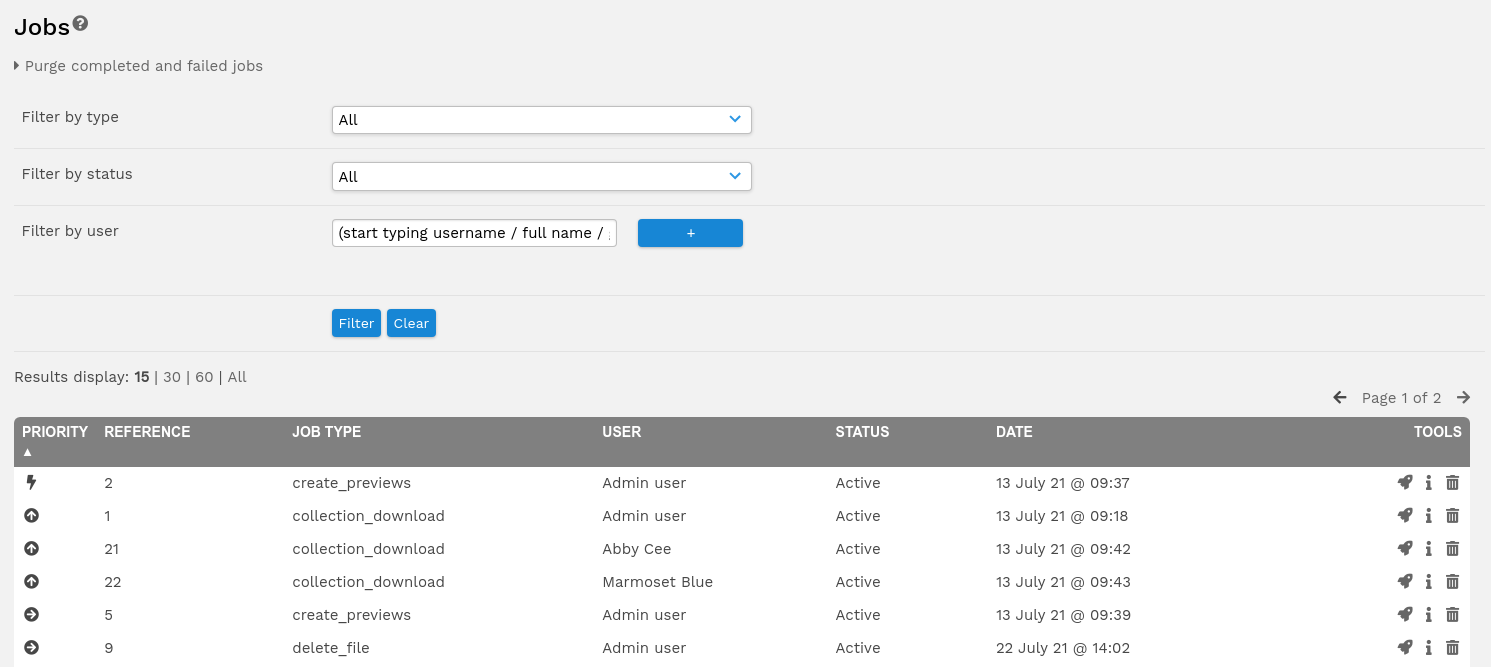
The page shows you the following information about jobs in the queue:-
- The job priority*
- The job reference
- The job type
- The user that created the job (admins only)
- The job status
- The earliest job start date
The tools column has the following options:-
- Delete the job (e.g. if no longer required or completed**)
- Job information (admins only). This will display the technical information about the job
- Reset job (admins only). The job will then be re-run
- Boost job (admins only). The job priority will be increased so that it will be the first job processed the next time the offline job script is run. If more than one job is boosted then the job with the earlier start date will take priority
* See notes on priority below
** Completed jobs will only appear if the configuration setting $offline_job_delete_completed is set to false.
Filtering the jobs
The page allows you to filter the jobs by job type, job status or the user that created the job to make it easier to see only those jobs that you are concerned with. To select a user start typing the name and then select the required user from the list that appears. To apply the filter click on the 'Filter' button.
Priority
The job priority is indicated by the following icons:-
- Urgent. Run before any other jobs
- User jobs - these are jobs that users are waiting on
- System jobs e.g. preview creation.
- Used to indicate completed jobs
Coming in v11+
User triggerable jobs
A new feature added to v11 will let users run data processing scripts from the front-end, allowing their system to be fully managed. These scripts allow functions to be performed against large batches of resources but many also offer options to target what gets processed.
A user requires the 'a', 'f*', 't' and 'v' permissions as well as edit access to all workflow states. They will then have access to select a job, configure any options and then queue the job for processing.
The jobs available to be triggered are:
- Recreate Previews - allows previews to be recreated in large batches, with options to control what gets recreated.
- Regenerate EXIF data - allows embedded file metadata to be used to update resource metadata.
- Purge duplicate resources - allows bulk identification and removal of duplicate resources, with optional dry run functionality to verify parameters. WARNING: this script can permanently delete files so use with caution. Please use the Dry run option to validate your settings if you are unsure.
- Re-index data - allows fields to be re-indexed.
- Update checksums - allows bulk updating of checksums which can be useful if configuration settings are changed.
- Update extracted text - allows bulk extraction of text from resources with suitable file types.
- Generate CLIP vectors - available when CLIP AI Smart Search is enabled. Allows CLIP vectors to be generated for new resources.
- Detect faces - available when AI Faces (InsightFace) is enabled. Allows face detection to run.
- Tag faces - available when AI Faces (InsightFace) is enabled. Allows face tagging to run with the option to run for certain collections only.
- Process unprocessed resources (Google Vision) - available when Google Vision is enabled. Allows unprocessed resources to be processed using Google's Cloud Vision API.
- Process unprocessed resources (Whisper) - available when Whisper is enabled. Allows Whisper audio transcription to run for suitable resources.
- Process existing GPT fields - available when OpenAI GPT is enabled. Allows specific, AI enabled fields to be updated using ChatGPT.
Job details view
Some new features added to v11 improve the Job details view. For all jobs, changes to Status, Priority and User fields have been made to show more information. For user triggerable jobs, there are the following new features:
- As the job starts running, the Progress field will show an approximate percentage completion. This can be refreshed by the user to quickly view the most up-to-date information from the script.
- For running jobs, there is also an option to Stream the log file directly to the browser. This gives more detailed information about what is being processed and the progress the script has made.
- Once a job is no longer In Progress, there is an option to Download the log file. This will allow the user to download a text file containing all logged information for that job. This is useful for reviewing (particularly on jobs that complete quickly), troubleshooting and validation of job parameters.
- Entries are added to the users Activity log for job creation, completion and deletion.