
The team at ResourceSpace have been a joy to work with, helping us manage what could've been a really difficult transition every step of the way.

Our friendly team can guide you through how our extensive feature list can be tailored to your exact needs
Request a meetingWe’ll configure the perfect digital asset management system, carefully tailored to your sector
Request a meetingWe provide powerful DAM systems and bespoke consultancy and support to organisations of all types across the world.
Request a meetingBlog
7th January 2026
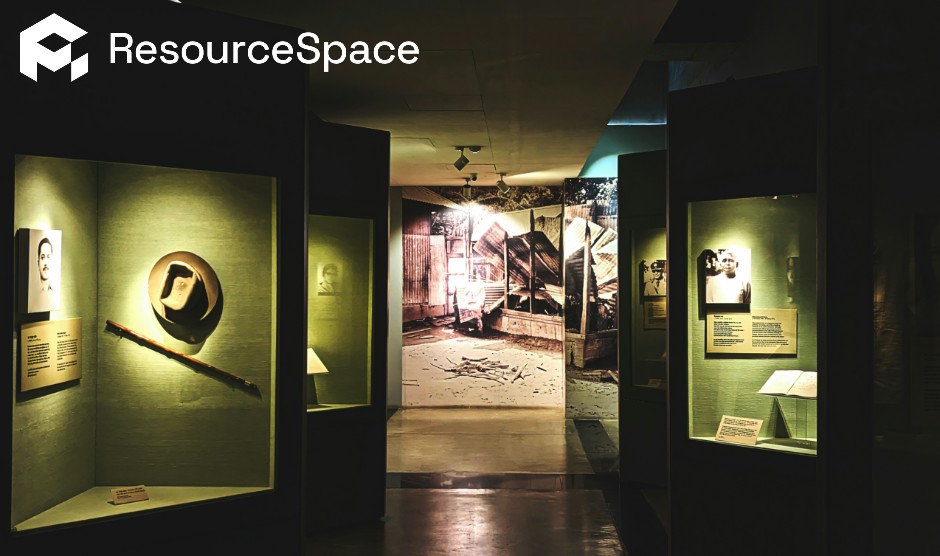
A dedicated Digital Asset Management (DAM) system is no longer a ‘nice-to-have’ for organisations, but an absolute necessity.
While this is the case for every industry, it’s something the arts and heritage sector has been aware of for some time, which is why much of our customer base is made up of museums, art galleries and heritage institutions.
In this article we’re going to take a closer look at what museums need to achieve with a DAM system, and why ResourceSpace is trusted by arts and heritage institutions all over the world.
Museums have unique and demanding requirements when it comes to Digital Asset Management, and their DAM system needs to support far more than simple file storage.
For the arts and heritage sector, a DAM must help preserve, organise and share vast collections of images, video, audio files and documentation, while making those assets accessible to a wide range of internal and external audiences.
At the heart of this is advanced metadata functionality, as museums need to capture information such as object provenance, owner, time period, location, rights, usage restrictions and much more. A DAM must support flexible structured metadata that aligns with curatorial and archival standards, while still being practical for day-to-day use by marketing, learning and research teams. Powerful search, often powered by AI, then allows users to quickly locate the right asset, even within very large collections.
Promoting exhibitions and programmes is another key priority, as museums need to surface approved, high-quality assets quickly for websites, social media, press and partner organisations. A DAM helps ensure teams are always using the correct images, videos and messaging, with clear permissions and version control in place.
Integrations with the existing tech stack is also critical, and a DAM must connect with collection management systems, websites and other platforms to avoid duplication and manual work, as well as to facilitate easy syncing of data.
Finally, museums need to be able to achieve all of this while remaining within tight budgets, meaning value for money is an important consideration. Museums need a DAM that delivers long-term efficiency, reduces risk and maximises the value of their digital collections across preservation, engagement and public access.
ResourceSpace is the DAM of choice for so many arts and heritage institutions, including The Ashmolean Museum, The History of Science Museum and LACMA, but what is it about the system that makes it so valuable to this sector?
There are five key reasons we’re going to explore:
An effective DAM relies on comprehensive metadata, and ResourceSpace’s advanced, AI-powered metadata functionality takes this to the next level.
The metadata schema in ResourceSpace is completely configurable and the system supports numerous field types. Our OpenAI integration powers automated tagging based on a range of complex instructions specific to your institution, including advanced outputs such as alt text and translations.
This saves arts and heritage DAM Managers hours of time previously spent manually tagging.
A DAM system allows arts and heritage institutions to bring their collections, not just to the general public that visits in person, but to a wider audience online. ResourceSpace makes this easy by providing an online hub for all digital artefacts, including public-facing collections that can be set to view-only for sharing on your website, social media and other online channels.
Our support for the International Image Interoperability Framework (IIIF) is also great for galleries and museums, enabling global collaboration between institutions and remote access to detailed information on an asset from any location. The IIIF’s advanced zoom capability is particularly useful for examining art and artefacts in high definition.
We’ve built custom integrations with The Museum System, EMu and MuseumPlus, enabling seamless integration with the Collections Management Systems you already use within your tech stack.
This integration syncs all data from one system to another—connecting a photograph or video with related data in the CMS, or automatically retrieving information stored in the CMS and bringing it into the DAM.
You can also connect ResourceSpace with your other systems thanks to our REST API.
If you use MONA, the cloud-based Digital Rights Management (DRM) platform for arts and heritage institutions, you can now streamline your licensing workflows easier thanks to our custom integration.
This integration allows you to import images and metadata from ResourceSpace directly into the DRM. This means any changes made within the DAM are automatically reflected in the licensing platform.
Arts and heritage institutions have to stay within tight budgets, often relying on donations, government grants or limited ticket sales to special exhibitions.
However, many DAM vendors price their software at very high price points, particularly for access to the most advanced functionality. By contrast, ResourceSpace offers enterprise-level Digital Asset Management without the price tag.
ResourceSpace is an open source DAM system and, unlike our competitors, we don’t charge a license fee.
Still unconvinced? Take a look at what our very happy arts and heritage customers have had to say about their ResourceSpace experience, including:
Ready to find out for yourself?
Book a free 30-minute demo below, or launch your free evaluation DAM portal within minutes and select the ‘Museum’ starting template.
#Museums
#ArtsAndHeritage
#Metadata
#IndustryNews
#BestPractice
#ProductUpdates
#Integration
#PublicAccess
#Efficiency
#CulturalInstitutions
#ExhibitionPromotion
The team at ResourceSpace have been a joy to work with, helping us manage what could've been a really difficult transition every step of the way.

I've found it extremely easy, comfortable, simple and fast. We are extremely happy with the tool and their support.