
Fairtrade communications staff around the world really appreciate ResourceSpace. It's proven invaluable as a one-stop for sharing and storing all our images and brand assets. I don't know how we'd manage without it!

Our friendly team can guide you through how our extensive feature list can be tailored to your exact needs
Request a meetingWe’ll configure the perfect digital asset management system, carefully tailored to your sector
Request a meetingWe provide powerful DAM systems and bespoke consultancy and support to organisations of all types across the world.
Request a meetingBlog
30th June 2026
We’ve just returned from Henry Stewart’s DAM Europe 2026 conference. It was an excellent event and I had a lot of interesting conversations with different people on a range of subjects. It’s no surprise that AI was the central topic across the conference and there were some really interesting new uses for AI on show, However there was a noticeable sense of "AI fatigue" in conversations between sessions.
It’s clear that AI offers significant value when implemented thoughtfully, with the human firmly in the loop and with environmental and ethical considerations prioritised. However, it feels as though some vendors are currently in a race to push AI as far as possible, regardless of the cost or practical utility. Large language models aren't free. They consume significant computing resources, so AI should solve meaningful problems rather than being added simply because it can.
There were many impressive demos, with Agentic AI being the latest trend. In one particularly impressive demo, driven entirely by a chat interface, the AI connected to a DAM, loaded logos and branding files, then linked to Canva to generate on-brand marketing materials - entirely hands-off. The resulting files were surprisingly decent. One presenter even suggested that the future of DAM UIs is no interface at all, as the system would only be accessed by AI. I struggle to imagine creative professionals, or those who brief them, feeling comfortable with such a disconnect.
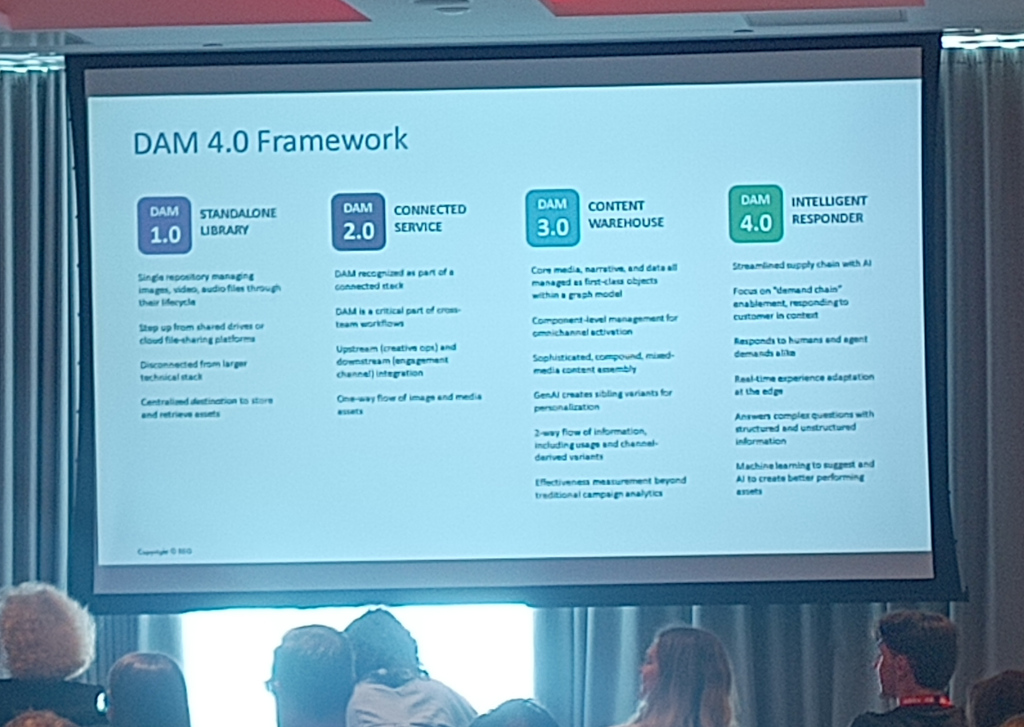
Conference hyperbole - clearly if you’re not using AI you can’t be “DAM 4.0”!
Despite the hype, if you aren't using agentic technology yet, you’re not alone. In one audience show of hands, nobody indicated they were currently using agentic technology with their DAM. For now, it exists firmly in the realm of the vendor demo and it’s not clear that this is something customers truly want; existing workflows are established for a reason, and human oversight remains essential in almost every scenario I’ve encountered.
Conferences are exactly the place to showcase ambitious ideas and experiment with what's possible. The challenge is distinguishing between an impressive demonstration and something that genuinely improves day-to-day work.
The “Great DAM Bake Off” provided an extreme example of technology prioritised over customer requirements.
Four vendors were given seven minutes to demonstrate a straightforward workflow: a campaign manager briefs a photographer, photos are uploaded, a designer makes adjustments, and the manager provides final approval. Absolute bread-and-butter stuff for any DAM.
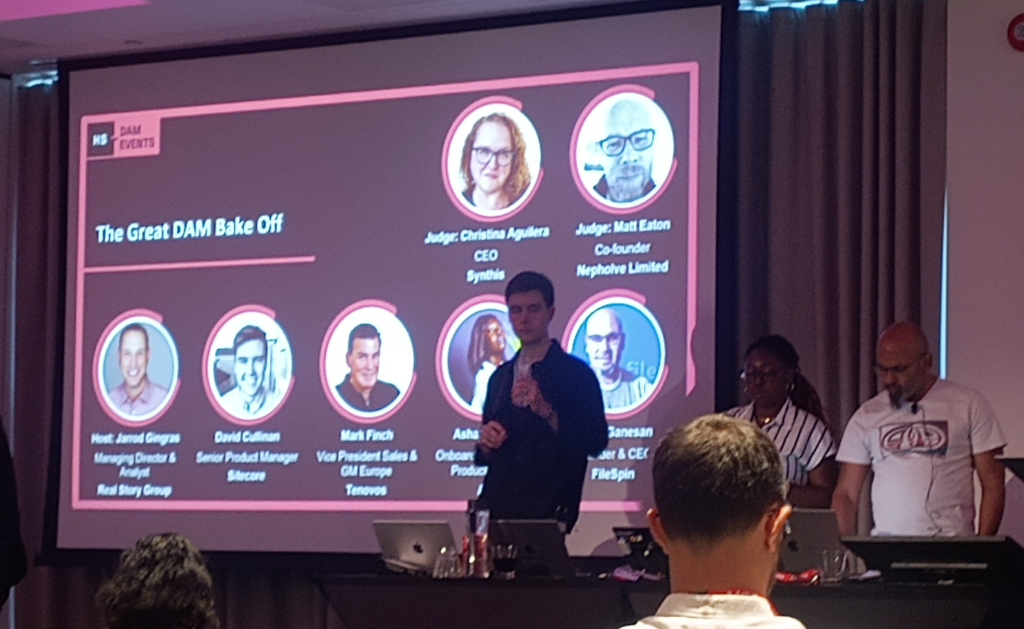 The Great DAM Bake Off. No soggy bottoms, just DAM demos.
Two vendors dutifully and somewhat successfully executed the workflow as requested. A third used the time for a generic demo unrelated to the brief, much to the chagrin of the judges. The fourth highlighted what I see as one of the current risks in the industry. The contestant proudly claimed that a single AI agent could replace the three humans in the process!
Several long prompts were then entered, each taking several minutes to execute, whereby AI would then complete the entire process. The necessity of human approval - clearly set out in the brief - was overlooked entirely. To me, it was a classic example of technology in search of a problem, and of a technologist pushing technology over stated customer requirements.
Unsurprisingly, he didn’t win, nor did the vendor who ignored the brief. The vote went to one of the vendors who actually listened. This underscored the current issue: some vendors are pitching AI as a universal solution, regardless of actual need. As the Jurassic Park quote goes: “Your scientists were so preoccupied with whether or not they could, they didn't stop to think if they should.”
I wasn’t entirely cynical about all the uses of AI in the conference, however. There were some genuinely interesting, thinking-outside-the-box uses of AI. For instance, one vendor demonstrated how a metadata scheme could be fed into a chat agent, which would then act as a consultant, asking questions about the use case to recommend schema improvements.
This is a compelling example of AI supporting the setup process rather than just being shoehorned into established workflows. Entirely new uses of AI, rather than AI just doing what we’re already doing, but faster.
At ResourceSpace, our approach is to use AI where it provides clear value to users. That means keeping humans in control, making AI optional, and focusing on practical improvements rather than replacing established workflows for the sake of it.
That said, it is interesting to note the shifting sentiment - more attendees now categorise themselves as “optimistic” rather than “uncertain” about AI's potential compared to previous events.
DAM EU reinforced something we've believed for some time: successful DAM projects aren't about using the most AI. They're about helping people manage digital assets more effectively. AI will undoubtedly become an increasingly important part of DAM. The challenge for all of us is ensuring it solves real customer problems rather than simply making for an impressive demo.
If you'd like to discuss ResourceSpace's approach to practical, ethical, human-centred AI, we'd love to hear from you.
#IndustryNews
#AI
#ResourceSpaceTips
#BestPractice
#CreativeWorkflows
#HumanOversight
#ProductUpdates
#MarketingMaterials
#AIImplementation
Fairtrade communications staff around the world really appreciate ResourceSpace. It's proven invaluable as a one-stop for sharing and storing all our images and brand assets. I don't know how we'd manage without it!

ResourceSpace has empowered our staff to find and access the content they need independently while allowing us to keep centralised control of assets and metadata.