
Fairtrade communications staff around the world really appreciate ResourceSpace. It's proven invaluable as a one-stop for sharing and storing all our images and brand assets. I don't know how we'd manage without it!

Our friendly team can guide you through how our extensive feature list can be tailored to your exact needs
Request a meetingWe’ll configure the perfect digital asset management system, carefully tailored to your sector
Request a meetingWe provide powerful DAM systems and bespoke consultancy and support to organisations of all types across the world.
Request a meetingBlog
9th July 2026
In June, ResourceSpace sponsored two Henry Stewart events in London: DAM Europe 2026 and DAM and Collections Management for Cultural Heritage 2026.
DAM Europe’s theme, The Intelligent Evolution of DAM, felt particularly apt this year, with many conversations focused on how DAM has moved (and is continuing to move) beyond static repositories into more active, intelligent, workflow-driven systems.
The cultural heritage event, co-located with DAM Europe, brought that conversation into a more specialist context, exploring how galleries, libraries, archives, museums and performing arts organisations manage digital assets not simply as content, but as part of long-term stewardship, scholarship and public access.
Across both events, one theme stood out very clearly - DAM has become a governance system as much as anything else.
I particularly enjoyed taking part in the DAM Europe panel “Rights, Licensing and Compliance in the AI Era” - alongside panellists from Vinted, Bacardi and Canon EMEA - and moderated by John Horodyski. The session focused on how DAM can help organisations manage legal permissions, restrictions, policy enforcement, usage tracking, intellectual property protection and access control.
One point I was keen to get across was that AI permissions can’t be reduced to a single “AI approved” yes/no field. This isn’t sophisticated enough for effective governance.
Organisations need to capture more granular information. Can this asset be used for AI training? Can it be used in AI-assisted editing? Can AI-generated derivatives be created from it? Are there restrictions on the model, channel, territory, supplier, or future use? Who assigned those permissions? When? And on what basis?
This is where the DAM has a crucial role to play. These permissions need to be explicit, accessible, searchable, enforceable and auditable. They also need to travel with the asset when it leaves the DAM, whether through a download, a publishing workflow, a creative tool integration or another connected system.
AI functionality itself also need to be scrutinised. All ResourceSpace’s AI tools are optional and they all run locally - on the same server on which the system is installed. There’s no processing by a third party, no training and no privacy concerns. I’d encourage anyone looking for a DAM, or already using one, to question vendors about their application of AI. Our AI policy is publicly available.
C2PA and Content Credentials are important developments in this area, providing a technical standard for establishing the origin and edits of digital content. But embedded provenance data should not be treated as the only source of truth. It can support governance, but it should sit alongside rights metadata, approval workflows, audit trails and organisational policy inside the DAM.
We discussed provenance and lineage in the panel too. A DAM can’t prove provenance if it was never captured in the first place. What it can do is preserve provenance, expose gaps and prevent assets with uncertain origins from being used in high-risk contexts.
Provenance tells us where an asset has come from and what has happened to it. Rights metadata tells users how it can be used. Both need to be available at the point of decision, not hidden in a spreadsheet, an email thread or someone’s memory.
For governance to work properly, the DAM workflow has to make the right behaviour the easiest behaviour. If relevant rights metadata is incomplete, the asset should not go live. If AI permissions are unknown, the asset should not be made available for AI-enabled workflows. If provenance is unclear, that uncertainty should be visible and actionable - and restrictions put in place to ensure the asset can’t be used inadvertently.
It’s important that AI rights governance doesn’t sit with a single person or team. It also can’t be delegated entirely to the DAM vendor. It has to be a joint process between legal, creative, Digital Asset Managers, collections teams, technologists and policy owners. The DAM’s role is to make those policies operational, so they’re constantly applied rather than a thought in the back of someone’s mind
jpeg_scr.jpg)
On day two, we shifted focus to cultural heritage and collections management with our presentation “Digital Curation: When Collections Come Alive.” The main idea was that digital curation is not just about storing files. It is about preserving meaning and making collections more accessible, discoverable and useful over time.
For museums and cultural heritage organisations, the measure of success is not just efficiency. Efficiency is important, of course, especially where teams are working with limited resources, but the bigger goal is wider public access, collaboration and discovery. Digital assets need to support interpretation, research, exhibitions, education, licensing, conservation and engagement.
That means DAM must work closely with collections management systems, preservation workflows and interoperable standards such as IIIF. Unique identifiers, accurate metadata, expert review, checksums, file integrity and clear labelling all contribute to a collection that can be trusted and reused. When those foundations are in place, digital collections can travel far beyond the walls of the institution responsible for them.
The case studies we discussed, including the Whitney Museum of American Art and In Flanders Fields Museum, showed how effective digital curation can bring collections to life. At the Whitney, for example, digital assets support a range of needs, from collections photography and TMS integration to rights-based media, loans, marketing and public access. The Sanborn Hopper Archive also demonstrates the value of digitisation at scale, with thousands of items made publicly available and new opportunities to present diaries, letters, early sketches and photographs to the public.
We also discussed wider cultural heritage platforms such as Europeana and Art UK, both of which show the power of making collections discoverable beyond the boundaries of a single institution. I think that is one of the most exciting parts of digital curation - giving people the opportunity to encounter art works they might otherwise never get to see.
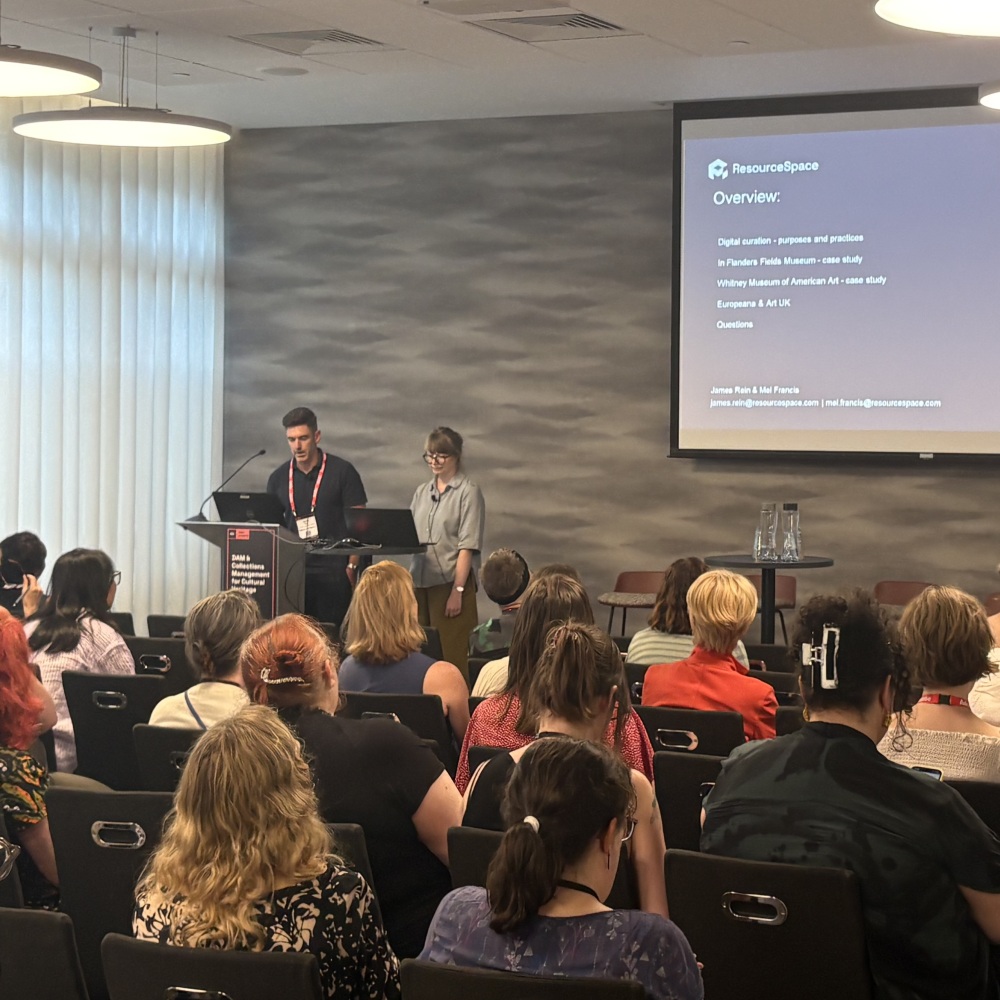
Away from the sessions, the event itself was a valuable opportunity to reconnect with the DAM community and we had lots of thoughtful conversations at our stand with other vendors, consultants and prospective clients.
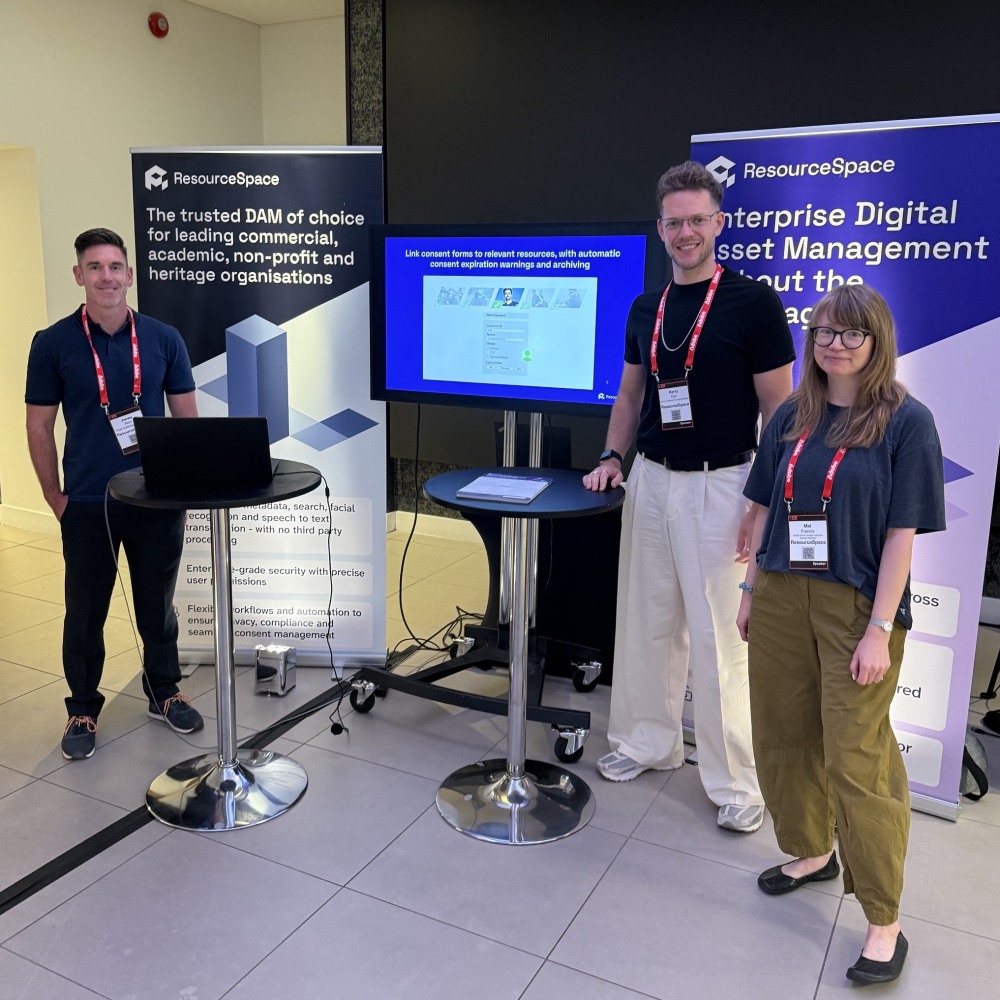
One of the nicest parts of the event was meeting existing clients in person, many for the first time. Our work with clients is always collaborative, but a lot of that collaboration happens through screens, calls and project meetings. Being able to speak face to face and understand where their priorities are was a real highlight. We’ve worked with a lot of our clients for many years and know them well so it was also nice to hear their personal news, holiday plans and what was on the agenda for their time in London or the UK - a lot had come from overseas!
We left the event with a very strong sense that DAM is becoming more central and more valuable to the way organisations work. As AI, rights, provenance, digital preservation and public access become more complex, organisations need systems that can support good decisions, not just store good files.
I'm looking forward to the next one!
Fairtrade communications staff around the world really appreciate ResourceSpace. It's proven invaluable as a one-stop for sharing and storing all our images and brand assets. I don't know how we'd manage without it!

ResourceSpace has empowered our staff to find and access the content they need independently while allowing us to keep centralised control of assets and metadata.